
Michigan County Seats Map: Complete Directory of All 83 County Capitals & Courthouses
The master civic guide to all 83 Michigan county seats and historic courthouses. Explore local government centers, municipal capitals from Detroit to Eagle River, founding dates, and printable PDF reference maps.
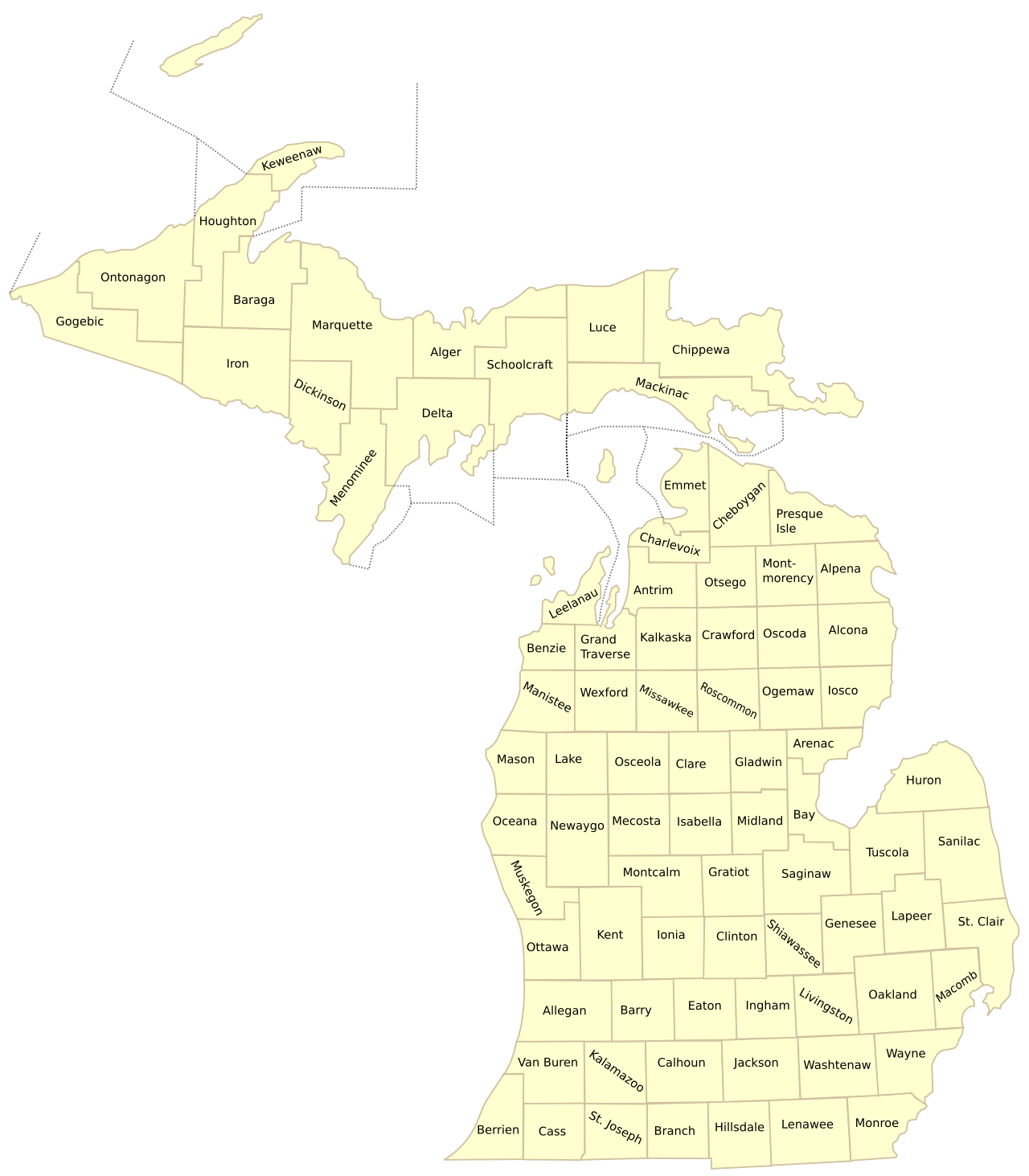
Download Michigan County Seats & Municipal Map PDFs
Accurate vector PDF downloads showing every county capital, courthouse location, and boundary jurisdiction across Michigan.
Alphabetical Directory: All 83 Michigan County Seats
Complete civic directory of county seats, corresponding county jurisdictions, year organized, population, and FIPS codes.
| County Seat | County Jurisdiction | Year Organized | County Population | FIPS Code | Region |
|---|---|---|---|---|---|
| Harrisville | Alcona County | 1869 | 10,167 | 26001 | Northern Lower |
| Munising | Alger County | 1885 | 8,769 | 26003 | Upper Peninsula |
| Allegan | Allegan County | 1835 | 120,502 | 26005 | West Michigan |
| Alpena | Alpena County | 1857 | 28,907 | 26007 | Northern Lower |
| Bellaire | Antrim County | 1840 | 23,431 | 26009 | Northern Lower |
| Standish | Arenac County | 1883 | 15,002 | 26011 | Mid-Michigan |
| L’Anse | Baraga County | 1875 | 8,158 | 26013 | Upper Peninsula |
| Hastings | Barry County | 1829 | 62,422 | 26015 | West Michigan |
| Bay City | Bay County | 1857 | 103,856 | 26017 | Great Lakes Bay |
| Beulah | Benzie County | 1863 | 17,970 | 26019 | Northern Lower |
| St. Joseph | Berrien County | 1829 | 154,316 | 26021 | Southwest Michigan |
| Coldwater | Branch County | 1829 | 44,862 | 26023 | Southern Border |
| Marshall | Calhoun County | 1829 | 134,310 | 26025 | Southwest Michigan |
| Cassopolis | Cass County | 1829 | 51,589 | 26027 | Southwest Michigan |
| Charlevoix | Charlevoix County | 1869 | 26,054 | 26029 | Northern Lower |
| Cheboygan | Cheboygan County | 1853 | 25,579 | 26031 | Northern Lower |
| Sault Ste. Marie | Chippewa County | 1826 | 36,785 | 26033 | Upper Peninsula |
| Harrison | Clare County | 1871 | 30,856 | 26035 | Central Michigan |
| St. Johns | Clinton County | 1831 | 79,128 | 26037 | Mid-Michigan |
| Grayling | Crawford County | 1879 | 12,988 | 26039 | Northern Lower |
| Escanaba | Delta County | 1861 | 36,903 | 26041 | Upper Peninsula |
| Iron Mountain | Dickinson County | 1891 | 25,947 | 26043 | Upper Peninsula (Central Time) |
| Charlotte | Eaton County | 1837 | 109,175 | 26045 | Mid-Michigan |
| Petoskey | Emmet County | 1853 | 34,057 | 26047 | Northern Lower |
| Flint | Genesee County | 1835 | 406,211 | 26049 | Flint / Mid-Michigan |
| Gladwin | Gladwin County | 1875 | 25,386 | 26051 | Central Michigan |
| Bessemer | Gogebic County | 1887 | 14,380 | 26053 | Upper Peninsula (Central Time) |
| Traverse City | Grand Traverse County | 1851 | 95,238 | 26055 | Northern Lower |
| Ithaca | Gratiot County | 1855 | 41,761 | 26057 | Central Michigan |
| Hillsdale | Hillsdale County | 1829 | 45,742 | 26059 | Southern Border |
| Houghton | Houghton County | 1845 | 37,361 | 26061 | Upper Peninsula |
| Bad Axe | Huron County | 1859 | 31,407 | 26063 | The Thumb |
| Mason | Ingham County | 1838 | 284,900 | 26065 | Capital Region |
| Ionia | Ionia County | 1831 | 66,804 | 26067 | West Michigan |
| Tawas City | Iosco County | 1857 | 25,237 | 26069 | Northern Lower |
| Crystal Falls | Iron County | 1885 | 11,631 | 26071 | Upper Peninsula (Central Time) |
| Mt. Pleasant | Isabella County | 1831 | 64,394 | 26073 | Central Michigan |
| Jackson | Jackson County | 1832 | 160,366 | 26075 | South Central Michigan |
| Kalamazoo | Kalamazoo County | 1829 | 261,670 | 26077 | Southwest Michigan |
| Kalkaska | Kalkaska County | 1871 | 17,939 | 26079 | Northern Lower |
| Grand Rapids | Kent County | 1831 | 657,974 | 26081 | West Michigan Hub |
| Eagle River | Keweenaw County | 1861 | 2,172 | 26083 | Upper Peninsula (Copper Country) |
| Baldwin | Lake County | 1871 | 12,096 | 26085 | West Central Michigan |
| Lapeer | Lapeer County | 1822 | 88,619 | 26087 | The Thumb / Metro Fringe |
| Suttons Bay | Leelanau County | 1840 | 22,301 | 26089 | Northern Lower |
| Adrian | Lenawee County | 1826 | 99,423 | 26091 | Southern Border |
| Howell | Livingston County | 1836 | 194,385 | 26093 | Metro Detroit Fringe |
| Newberry | Luce County | 1887 | 5,339 | 26095 | Upper Peninsula |
| St. Ignace | Mackinac County | 1818 | 10,834 | 26097 | Upper Peninsula (Straits) |
| Mount Clemens | Macomb County | 1818 | 881,217 | 26099 | Metro Detroit / Lake St. Clair |
| Manistee | Manistee County | 1855 | 25,032 | 26101 | Northern Lower |
| Marquette | Marquette County | 1843 | 66,017 | 26103 | Upper Peninsula Hub |
| Ludington | Mason County | 1855 | 29,052 | 26105 | West Michigan Coast |
| Big Rapids | Mecosta County | 1859 | 39,714 | 26107 | Central Michigan |
| Menominee | Menominee County | 1861 | 23,502 | 26109 | Upper Peninsula (Central Time) |
| Midland | Midland County | 1850 | 83,494 | 26111 | Great Lakes Bay |
| Lake City | Missaukee County | 1871 | 15,052 | 26113 | Northern Lower |
| Monroe | Monroe County | 1817 | 155,274 | 26115 | Lake Erie Shoreline |
| Stanton | Montcalm County | 1831 | 66,614 | 26117 | Central Michigan |
| Atlanta | Montmorency County | 1881 | 9,153 | 26119 | Northern Lower |
| Muskegon | Muskegon County | 1859 | 176,511 | 26121 | West Michigan Coast |
| White Cloud | Newaygo County | 1851 | 49,978 | 26123 | West Central Michigan |
| Pontiac | Oakland County | 1819 | 1,274,395 | 26125 | Metro Detroit Hub |
| Hart | Oceana County | 1855 | 26,585 | 26127 | West Michigan Coast |
| West Branch | Ogemaw County | 1875 | 20,770 | 26129 | Northern Lower |
| Ontonagon | Ontonagon County | 1843 | 5,811 | 26131 | Upper Peninsula |
| Reed City | Osceola County | 1871 | 22,891 | 26133 | Central Michigan |
| Mio | Oscoda County | 1881 | 8,219 | 26135 | Northern Lower |
| Gaylord | Otsego County | 1875 | 25,091 | 26137 | Northern Lower |
| Grand Haven | Ottawa County | 1837 | 296,200 | 26139 | West Michigan Lakeshore |
| Rogers City | Presque Isle County | 1871 | 12,982 | 26141 | Northern Lower |
| Roscommon | Roscommon County | 1875 | 23,459 | 26143 | Northern Lower |
| Saginaw | Saginaw County | 1835 | 189,591 | 26145 | Great Lakes Bay |
| Sandusky | Sanilac County | 1848 | 40,611 | 26151 | The Thumb |
| Manistique | Schoolcraft County | 1843 | 8,047 | 26153 | Upper Peninsula |
| Corunna | Shiawassee County | 1822 | 68,094 | 26155 | Mid-Michigan |
| Port Huron | St. Clair County | 1820 | 160,383 | 26147 | Blue Water / The Thumb |
| Centreville | St. Joseph County | 1829 | 60,939 | 26149 | Southern Border |
| Caro | Tuscola County | 1840 | 53,323 | 26157 | The Thumb |
| Paw Paw | Van Buren County | 1829 | 75,587 | 26159 | Southwest Michigan Coast |
| Ann Arbor | Washtenaw County | 1826 | 372,258 | 26161 | Southeast Michigan |
| Detroit | Wayne County | 1796 | 1,793,561 | 26163 | Metro Detroit Urban Core |
| Cadillac | Wexford County | 1869 | 33,673 | 26165 | Northern Lower |
Historical Courthouse Contests & County Seat Relocations
In nineteenth-century Michigan, securing designation as the official county seat was often a matter of economic life or death for frontier towns. The presence of the county courthouse, land registry office, and judicial circuit court guaranteed a constant influx of attorneys, land speculators, merchants, and hotel guests. As a result, several Michigan counties witnessed fierce political and legal battles between rival settlements vying for the county seat:
Fascinating Historical County Seat Battles:
- Ingham County (Mason vs. Lansing): When Lansing was selected as Michigan’s state capital in 1847, civic leaders in Lansing repeatedly attempted to wrest the county seat away from Mason. However, Mason held onto the historic seat through legislative maneuvering, establishing the unique situation where Lansing is the state capital, but neighboring Mason remains the official county seat of Ingham County.
- Van Buren County (Paw Paw vs. Lawrence vs. South Haven): Paw Paw was established as the county seat in 1837. In the late nineteenth century, centrally located Lawrence and booming Lake Michigan port South Haven led multiple referendums to relocate the courthouse. Paw Paw citizens raised private funds to erect a magnificent Romanesque courthouse in 1901, permanently cementing its status.
- Shiawassee County (Corunna vs. Owosso): Despite Owosso growing into Shiawassee County’s dominant industrial and rail city, neighboring Corunna retained the county seat designation, constructing a stately neoclassical brick courthouse that continues to serve county government today.
The Constitutional & Administrative Roles of Michigan County Seats
Under Article VII of the Michigan Constitution of 1963, counties function as primary administrative subdivisions of state government. The county seat serves as the centralized civic campus housing vital constitutional offices that touch the everyday lives of property owners and citizens:
- Circuit Courts & Judicial Administration: Each county seat hosts the state’s Circuit Court, District Court, and Probate Court jurisdictions, administering felony criminal trials, civil lawsuits, estate probate, family relations, and juvenile justice.
- County Clerk & Register of Deeds: Responsible for maintaining the official public land title chain, recording warranty deeds, mortgages, easements, surveys, and vital records (birth, marriage, and death certificates), as well as administering state and federal election canvassing.
- County Board of Commissioners: The legislative policy-making body responsible for adopting county budgets, appropriating public safety funds, managing public parks, and overseeing health and human service departments.
- County Sheriff & Jail Operations: Headquartered at the county seat, the sheriff’s office operates the centralized county correctional facility, provides 911 dispatch communication, and delivers law enforcement patrol coverage across rural civil townships.
- County Drain / Water Resources Commissioner: A unique Michigan constitutional office responsible for designing, constructing, and maintaining hundreds of miles of agricultural drainage ditches, stormwater retention basins, and inland lake level control structures.
Architectural Heritage of Historic Michigan Courthouses
Michigan’s county seats showcase some of the finest civic architecture in the Great Lakes region, reflecting the prevailing design movements of the late nineteenth and early twentieth centuries. From the monumental Richardsonian Romanesque sandstone towers of the Marquette County Courthouse to the French Second Empire mansard roofs of the Allegan County Courthouse, and the classical Beaux-Arts domes of Ingham and Calhoun counties, these civic monuments embody local community pride and democratic governance.
Courthouse Architectural Styles Across Michigan County Seats
The physical county courthouse is often the most prominent and ornate public building in a county seat, serving as an architectural time capsule of the era in which the county prospered. Across Michigan’s 83 county seats, four distinct architectural movements dominate the landscape:
Primary Courthouse Architectural Eras:
- Richardsonian Romanesque (1880–1905): Defined by massive rough-hewn stone masonry, heavy round archways, and imposing clock towers. Exemplified by the Marquette County Courthouse (built from local red Jacobsville sandstone), the Van Buren County Courthouse in Paw Paw, and the Eaton County Courthouse in Charlotte.
- Beaux-Arts Classical Revival (1895–1920): Characterized by grand symmetrical limestone facades, Corinthian columns, triangular pediments, and elevated domes. Celebrated examples include the historic Wayne County Building in downtown Detroit, the Lenawee County Courthouse in Adrian, and the St. Joseph County Courthouse in Centreville.
- Italianate & French Second Empire (1865–1885): Featuring elaborate cast-iron window hoods, overhanging eaves supported by decorative brackets, and steep mansard roofs crowned with wrought-iron cresting. Notable examples include the Allegan County Courthouse in Allegan and the Branch County Courthouse in Coldwater.
- Art Deco & Mid-Century Modern (1930–1965): Featuring clean vertical geometric lines, limestone reliefs, and streamlined municipal efficiency. Represented by the Bay County Building in Bay City and the Midland County Courthouse, which uniquely features indigenous exterior murals crafted using Dow Chemical magnesite stucco.
Visiting Michigan’s County Seats: Public Access & Genealogy Research:
Beyond administrative governance, county courthouses and clerk offices are invaluable repositories for family historians and genealogical researchers. Most county clerk and register of deeds offices maintain public search terminals allowing citizens to trace ancestral land deeds, nineteenth-century plat maps, naturalization records, and historical probate wills dating back to each county’s initial territorial establishment.
County GIS Parcel Mapping & Register of Deeds Land Records
In addition to judicial proceedings, the county seat is the ultimate authority for real estate land records, property boundary descriptions, and spatial property tax records across Michigan. Every parcel of privately owned land, commercial facility, agricultural acreage, and public right-of-way within a county is indexed and permanently maintained by county administrative departments headquartered at the county seat:
Core Cartographic & Land Administration Functions at Michigan County Seats:
- Interactive County GIS Parcel Viewers: Nearly all 83 Michigan county seats now maintain public online GIS web mapping portals (such as Oakland County Access, Kent County GIS, and Traverse City/Grand Traverse County GIS). Property buyers, title insurance examiners, and land surveyors can search tax parcels by Parcel Identification Number (PIN), verify property boundaries, review satellite aerial imagery, and inspect topographic contour elevations.
- Register of Deeds Official Recordings: Maintains the permanent historical index of all deeds, mortgages, land contracts, federal tax liens, construction mechanics liens, and utility easements. These public records establish legal chain of title and protect private property ownership rights dating back to initial statehood land patents.
- County Plat Boards & Subdivision Planning: Governed by the Michigan Land Division Act (Public Act 288 of 1967), the County Plat Board—composed of the Register of Deeds, County Clerk, and County Treasurer—reviews and approves all new residential subdivision plats, condominium site plans, and dedicated public rights-of-way prior to municipal recording.
- County Equalization Departments: Headquartered at the county courthouse, equalization directors survey real estate transactions across all civil townships, cities, and incorporated villages to calculate county-wide taxable valuations and ensure equitable property tax assessments under Michigan Proposal A of 1994.
Public Information Access & Open Meeting Protocols:
All official proceedings conducted at Michigan county seats—including Board of Commissioners meetings, planning commission hearings, and road commission sessions—are strictly governed by the Michigan Open Meetings Act (Public Act 267 of 1976) and Freedom of Information Act (FOIA). Citizens are entitled to attend public deliberations, examine county administrative budgets, and access cartographic planning documents directly at the county courthouse or via online streaming portals.
What is the legal process required under Michigan law to relocate a county seat?
Under Article VII, Section 10 of the Michigan Constitution of 1963, removing or relocating an established county seat requires an extraordinary dual-hurdle legal threshold. First, the proposed relocation must receive the affirmative approval of a two-thirds supermajority vote of the elected County Board of Commissioners. Following board approval, the proposed relocation proposition must then be submitted directly to a county-wide popular vote during a general election, where it must receive the approval of a majority of the county’s registered electors voting on the question. This stringent statutory requirement ensures that county seats remain permanent civic anchors resistant to temporary political factions.
Frequently Asked Questions: Michigan County Seats
Why is Mason the county seat of Ingham County instead of Lansing?
When Ingham County was organized in the 1830s, Mason was selected because of its central geographic location within the county. When the state capital was relocated from Detroit to Lansing Township in 1847, Mason retained its official status as the county seat, which it maintains to this day.
What is the oldest county seat in Michigan?
Detroit (Wayne County) is Michigan’s oldest organized county seat, formally organized under the Northwest Territory in 1796.
What is the newest county seat in Michigan?
Iron Mountain (Dickinson County) is Michigan’s newest county seat, established when Dickinson County was formed in 1891 as Michigan’s 83rd and final county.
Furthermore, historical archives preserved at county courthouses often contain early nineteenth-century hand-drawn surveyor notes, territorial land patents signed by early Michigan governors, and original civil township incorporation charters.